
SOURYADEEP BHATTACHARYYA

.png)
.png)
.png)
Music, for Souryadeep, is not a single tradition but a living conversation. Rooted in the rigour of Hindustani classical training, his work moves across three distinct musical worlds — the depth of classical raga, the openness of world music collaboration, and original creative projects that bring the sarod into new dialogues. Explore his music below!

Raga Madhuvanti with Sudhakar Vaidyanathan

World Music with
Spruce Ritual
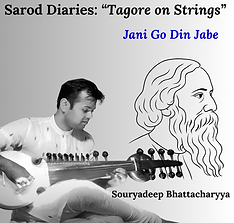
Sarod Diaries: Tagore on Strings, Album Release

About the Sarod - A Brief History

The sarod and rabab together — ancestor and descendant
Long before the sarod, was the rabab — a short-necked lute native to central Asia that came to India carried across the Khyber Pass by Afghan horse traders, cavalry officers, and wandering musicians. It was a folk instrument then: road-hardened, practical, played to keep spirits high on long marches. What it became, the sarod, is one of music's most quietly astonishing stories of transformation.
As Afghan musicians settled in the Gangetic plains —especially in Shahjahanpur and Rampur— the rabab began its transformation. Contact with dhrupad music and its masters, and the demands of playing Hindustani classical music on the rabab gradually reshaped the instrument: the wooden fingerboard gave way to polished steel, gut strings to metal, frets removed entirely so that raga's essential glide — the meend — could flow uninterrupted.
Afghan musicians became court musicians of Indian Maharajas, and their descendants produced the instrument we now call the sarod. This lineage runs through several legends across major gharanas into the living tradition that Souryadeep Bhattacharyya from Kolkata carries today in his modern sarod, transmitted to him by his Guru, the Pt. Alok Lahiri. When he draws his plectrum across the steel fingerboard, he is playing a relatively modern instrument with ancient roots that trace back to Central Asia.
It is this instrument that Souryadeep has devoted his life to — carrying its voice from Kolkata to concert stages across continents.